
Australian accounting practices continue to face persistent capacity constraints as client demand grows and the local talent pipeline remains under pressure. According to a CA ANZ survey of members who advertised vacancies across January to December 2025, vacancy fill rates for general accountants and external auditors sat at 49 per cent, while tax accountants reached only 55 per cent. Rates below 67 per cent signal a high likelihood of shortage, with external auditor roles taking an average of 113 days to fill.
These figures, released in early 2026 as part of CA ANZ’s contribution to the 2026 Occupation Shortage List process, sit alongside longer-term projections of a shortfall of around 6,000 accountants by 2030. For firm owners and partners, the practical question is how to expand client capacity, maintain service quality and protect margins without matching every growth step with proportional local headcount increases.
Many practices are finding that a combination of process discipline, technology, clearer capacity forecasting and carefully structured additional support can deliver measurable scale. The approaches outlined below are repeatable tactics already in use across Australian firms seeking sustainable growth.
Understanding the Constraints on Traditional Scaling
Hiring remains difficult. Lack of experienced applicants is the most commonly cited reason for unfilled roles, according to the same CA ANZ survey. At the same time, demand for accountants and related professionals was reported as higher or much higher by 35 per cent of respondents in 2025 compared with the prior year. The result is longer recruitment cycles, elevated salary expectations and increased pressure on existing teams during peak periods.
Simply adding local full-time staff at the same rate as revenue growth is no longer the default path for many practices. Instead, firms are examining where work can be standardised, automated or redistributed so that growth does not require a linear increase in onshore headcount.
Practical Ways to Scale Practice Without Headcount Increases
Several interconnected tactics allow practices to lift capacity while keeping local team size more stable. These methods work best when applied together rather than in isolation.
Standardise Workflows and Documentation
Inconsistent processes create hidden capacity drains. When every team member follows slightly different steps for the same compliance task, review time rises and quality control becomes harder. Practices that map core workflows, document them clearly and enforce consistent templates reduce variation. This frees senior time for client-facing work and makes it easier to bring additional capacity online quickly when needed.
Clear role definitions also help. Separating routine preparation from review and client communication allows less experienced or support team members to handle volume work while seniors focus on higher-value activities.
Apply Technology and Automation to Routine Tasks
Automation tools now handle significant portions of transaction coding, bank reconciliation support, document collection and basic reporting preparation. When combined with strong review frameworks, these tools reduce the hours spent on repetitive work. Progressive practices report that continuous efficiency improvement and real-time data access support both productivity and client service without requiring matching headcount growth.
The key is selective application. Automation works best on high-volume, rules-based tasks, leaving judgement, interpretation and relationship work with qualified local staff.
Improve Capacity Planning and Client Portfolio Management
Many firms still operate with limited forward visibility of workload. Tracking historical utilisation, building buffers into schedules and applying clearer client acceptance criteria tied to available capacity help prevent overload. Some practices review client profitability regularly and adjust service levels or pricing where the work no longer fits available resources.
This disciplined approach supports measured growth. It allows practices to take on new clients or expand services only when capacity exists, rather than relying on continuous recruitment to absorb demand spikes.
Redesign Roles and Upskill Existing Teams
Restructuring how work is distributed can create senior capacity faster than external hiring. By shifting routine compliance and bookkeeping tasks away from partners and managers, firms free time for advisory conversations, business development and complex problem-solving. Targeted cross-training further increases internal flexibility so that absences or peak periods do not immediately create bottlenecks.
These internal adjustments reduce dependence on finding scarce experienced local candidates for every incremental role.
Integrate Additional Support Through Hybrid Models
A growing number of Australian practices are combining local teams with structured additional support. Hybrid arrangements that include dedicated remote or offshore capacity, when integrated into existing firm procedures and quality controls, allow volume work to move without expanding the local payroll at the same rate. Cloud collaboration tools, standardised documentation and clear communication protocols make these models practical.
When additional support follows the firm’s own workflows and remains under local review, the result is expanded throughput while local headcount growth stays more measured. This approach directly addresses the challenge of how to scale practice without headcount increases in a tight talent market.
Putting the Tactics Together
The most effective practices treat these elements as a system. Standardised processes make automation more reliable. Better forecasting guides decisions about where additional support is required. Role redesign ensures that the local team focuses on work that benefits most from proximity and relationship knowledge.
None of these steps eliminates the need for skilled local professionals. They do, however, change the ratio between revenue growth and local headcount, protecting margins and reducing burnout risk during peak seasons.
Firms that monitor utilisation, review process efficiency regularly and remain selective about client intake tend to find more sustainable paths to expansion. The data on continuing shortages makes clear that traditional linear hiring will remain challenging for the foreseeable future. Practices that build capacity through process, technology and flexible support structures position themselves to grow on their own terms.
Capacity Solutions
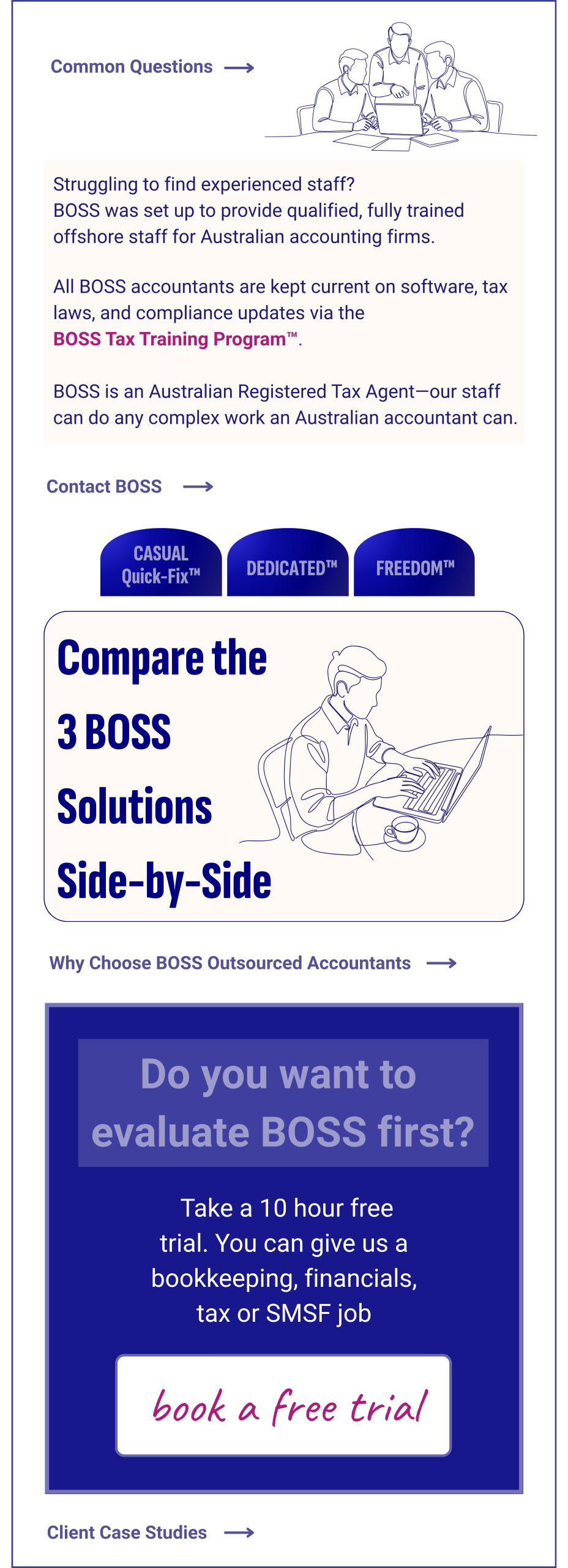
Many Australian accounting practices are using flexible outsourcing arrangements to manage fluctuating workloads without long-term hiring commitments. BOSS Outsourced Accounting can place experienced accountants and bookkeepers into your firm within a week through options like the Casual Quick Fix Solution. All staff are trained through the BOSS Tax Training Program™ and handle complex compliance work on a fixed-fee basis. This approach lets firms quickly add capacity when needed while keeping their onshore team focused on higher-value client relationships.
Learn more about available support options on our outsourced accounting services page.
Sources
CA ANZ survey of members advertising vacancies January–December 2025, reported April 2026 as input to the 2026 Occupation Shortage List process.
CA ANZ recommendations for inclusion of general accountants, taxation accountants and external auditors on the 2026 Occupation Shortage List.
Future Skills Organisation Workforce Plan 2025 projections on accountant and finance workforce shortfalls to 2030.
Accountants Daily reporting on CA ANZ survey findings and scalable support models in Australian accounting firms, 2026.
Frequently Asked Questions
Why is scaling with proportional local headcount becoming harder for Australian practices?
CA ANZ data from vacancies advertised in 2025 shows fill rates for key accounting roles between 40 and 55 per cent, well below the 67 per cent threshold that indicates shortage. Average time to fill external auditor roles reached 113 days. Combined with a projected shortfall of around 6,000 accountants by 2030, linear local hiring is slower and more costly than in previous cycles.
What is the first practical step most firms take to improve capacity?
Standardising core workflows and documentation is often the highest-return starting point. Consistent processes reduce review time, lower variation in quality and make it easier to introduce additional capacity or automation later without creating new bottlenecks.
How does automation help without replacing qualified staff?
Automation handles high-volume, rules-based tasks such as initial transaction coding, reconciliation support and document organisation. Qualified local accountants retain responsibility for review, interpretation, client communication and complex compliance decisions. The net effect is more capacity from the existing team rather than headcount reduction.
Can capacity planning reduce the need for urgent hiring?
Yes. Tracking historical utilisation, building schedule buffers and linking client acceptance to available capacity helps practices avoid overload. Regular portfolio reviews further ensure that growth aligns with realistic resources rather than relying on continuous recruitment.
How do hybrid or additional support models fit into a scaling strategy?
When additional support is integrated into the firm’s own procedures, subject to local review and supported by clear communication protocols, it expands throughput for volume work. Local teams can then focus on higher-value activities. This combination allows practices to grow without matching every increment of demand with new local full-time roles.
Do these tactics still require investment in local talent development?
Yes. Role redesign, cross-training and continuous improvement remain essential. The goal is not to eliminate local hiring but to change the ratio between growth and headcount so that scarce experienced professionals are used where they create the most value.
How recent is the data on accountant shortages?
The primary vacancy fill-rate statistics come from a CA ANZ survey of roles advertised throughout 2025 and published in April 2026. Longer-term shortfall projections to 2030 are drawn from Future Skills Organisation modelling and related CA ANZ analysis released or updated in 2025–2026.
Related Resources
Outsourcing & Staffing Solutions